
The Project
And just like that, I find myself on the other side of mastering these tracks. Unfortunately, mixing and mastering can be some of the most tedious processes in music-making while somehow simultaneously being some of the most fun parts. It really depends on the day, I find. What am I mixing and mastering for? Well, I am working on my first tracks as a solo artist and using it as the project for me Careers in Music course! If you want to read a little more on what that means, I recommend starting from the beginning of this series for a quick recap. So, in the interest of getting to it already, let’s talk mixing and mastering!
The Art
So first, what is mixing and mastering? Most people seem to have a grasp on the mixing part but are generally confused by what mastering is or how it differs from mixing. It can absolutely be confusing, but with a few key ideas, it can be easy to know the difference. Firstly, mixing is the process of balancing all of the individual elements of a song, while mastering focuses on the song as a whole and its relationship to other songs in the album or on the streaming site that you are using. More on that later.
Now the word mixing can also apply to other career fields within audio, but this definition is a pretty simple way to understand it from the production side. This process can include (depending on who you ask) changing individual instrument balances with volume, changing and tweaking any effects that you might be using, applying effects to the entire track as a “pre-mastering phase”, editing portions of the song to fit arrangement changes or fix timing errors, or even adding elements or overdubbing instruments to better serve the song. Again, there are plenty of engineers and producers that will disagree with some of these steps and yes, that’s a lot of possibilities. The most important part is knowing that mixing is a very broad term. In my process, mixing generally looks more like balancing and tweaking effects because I am generally writing my music in a very different headspace than I am mixing and I find it hard to prepare to mix and then edit parts or write new notes.
Mastering, on the other hand, is a process that is generally meant to prepare the song for whatever media the artist is using to distribute their work. In most cases today, this means making sure that your song is prepped for streaming services. It may also mean preparing your song for physical media like CD or vinyl releases. In most cases, mastering involves a few different steps to prepare the media. Normally, this starts with a final equalization process just to fine tune the song followed by an application of any combination of other effects that are used as broad and sweeping tools to sweeten, warm, or otherwise make the song sound “better”. There are, of course, some big buzz words with mastering. One of those is LUFS. Without getting into the scary technical conversation, LUFS can be thought of as digital loudness and it takes into account that humans do not hear frequencies linearly. Every streaming service has their own compression and normalization algorithms, and the conventional knowledge is that mastering is mostly the time to dial in the LUFS level for streaming services. In reality, mastering is a lot of things, and not simply an opportunity to win the loudness war. We won’t go into what that means here, but if you are looking for a fun YouTube rabbit hole, go search loudness war.
So what did I do to mix and master? Well, basically that. Let’s start with the mixes. Most of this process was dialing in the sounds that I wanted, balancing each of the parts, and adding in some fade ins/outs to clean up some of the edges. Below are a couple different mixes from each of the tracks I am working on. See if you can spot the differences!
Track 1
Track 2
So that is mixing. It can be very, very detailed. Or not. Again, it depends. Now onto the mastering. For this project, and for most of my work nowadays, I am using iZotope products. iZotope is a company that specialized in user-friendly and powerful plug-ins for producers. While there are plenty of other options in the production world, I use iZotope because they are easily accessible with a monthly subscription option and because I like to demonstrate to my students that plug-ins don’t have to be expensive, and they don’t have to be scary. For mastering, I am using Ozone 11. Ozone has a relatively new AI feature that listens to your track and creates a recommendation for the mastering chain and settings. I LOVE using this for a quick pass on demo projects. If I need to spit out a project really quickly (as in, within a few hours) this is a great cheat code to getting “close enough”. In this instance, I started with the recommendation, but there were plenty of tweaks made, especially in the limiting portion on the back end. Limiting is the very last part of a chain that, essentially, controls the master volume and helps you set the LUFS. I used Insight Pro to read the LUFS over time and give me other useful information like the stereo imaging.
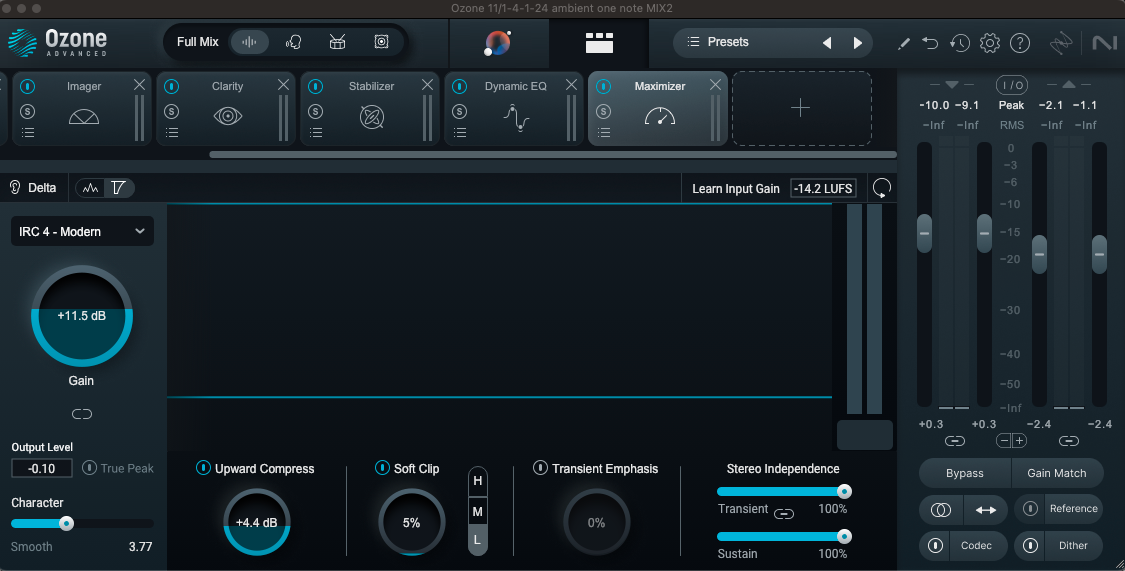
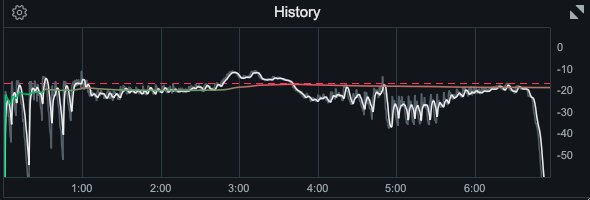
So, what does the master sound like and how is it different than the mixes? Well, listen to them and see if you can tell. Keep in mind that all of the files that you are hearing are compressed to MP3s before upload and are then further compressed by my website hosting service. To really hear the difference, you would need to listen to lossless versions, but this is close enough to hear the difference.
The Resistance
Ok, now for the elephant in the room. Yes, I am still technically a week behind, but only sort-of. My final week update was actually scheduled to be uploaded today, but I will have to save that for later in the week. The reason? Well, there is one very important step that I have to take before finishing the tracks and uploading them. The tracks need names. I need a name. I am still quite on the fence about this one and they will just have to wait until I finally make a decision. BUT the good news is that the artistic part of the project is done. My original projection was to finish the masters of the tracks by today and that is done. Does that technically make me mostly on track? Sometimes, I find it hilarious how I can manage to do all of the hard work first and save the simplest tasks for the end.
I found a garden in my back yard
With flowers full of life and purpose
I wished just for one day
That I could be
Be just like one of them
And be free
-Square Peg Round Hole
 Griffin Law